

Paid Advertising Strategies for Home Builders
For a home builder, the path from a search query to a signed contract is rarely a straight line. A buyer may spend weeks comparing communities, floor plans, and financing options before they ever fill out a form or pick up the phone. Pay-per-click (PPC) advertising lets you meet those buyers at the exact moment they are searching, with spend you can measure, targeting you can control, and results you can tie directly back to revenue.
Done well, PPC is one of the most dependable ways to generate qualified leads in a competitive new-construction market. Done poorly, it quietly drains your budget on clicks that never become buyers. The strategies below reflect how paid search actually works for builders today, including the platform changes and AI-driven tools that have reshaped Google Ads in recent years.
| Key Takeaways PPC places your homes in front of buyers with active intent, often within hours of launching a campaign.Location-specific, long-tail keywords attract qualified buyers and filter out casual browsers.Location assets, formerly called location extensions, display your address, phone number, and map pin inside your ads.Every ad should point to a dedicated landing page built for one specific audience and intent.Smart Bidding and Performance Max can lift results, but only when accurate conversion tracking sits behind them.Measure cost per sale and lead quality, not just clicks and cost per lead. |
Why PPC Works So Well for Home Builders
A new home is one of the largest purchases most people will ever make, and nearly all of the early research happens online. By the time a buyer contacts you, they have often visited your community pages more than once, watched a virtual tour, and compared you against several competitors. Paid search lets you appear at the top of the results during that entire journey, not just at the end of it.
Unlike organic SEO, which builds momentum over months, a well-structured PPC campaign can put you in front of high-intent buyers within hours of going live. That makes it the fastest way to fill your pipeline when you launch a new community, release move-in-ready inventory, or need to hit a quarterly sales target. The tactics that follow will help you turn that visibility into qualified leads rather than wasted clicks.
1. Start With Location-Specific, High-Intent Keywords
Home builders operate in defined markets, yet broad terms like “custom home builders” compete nationally and attract people who are nowhere near your communities. Adding geographic and intent modifiers focuses your budget on buyers who can actually purchase from you. Instead of bidding on a generic phrase, target searches such as “new homes in Loudoun County,” “custom home builder near Washington, DC,” or “move-in ready homes in Gainesville, VA.”
Long-tail keywords like these are more specific, less expensive, and far more likely to reach a serious buyer. Before you build your list, research the locations and phrases your competitors target, and study the language buyers actually type. If you build farmhouses and estate homes, a more rural service area may convert better than a dense urban one. Choose the markets that fit the homes you sell.
Just as important, build a strong negative keyword list. Excluding terms such as rent, apartment, jobs, salary, and DIY stops you from paying for clicks that will never turn into a sale.
2. Use Location Assets to Show Up Where Buyers Are
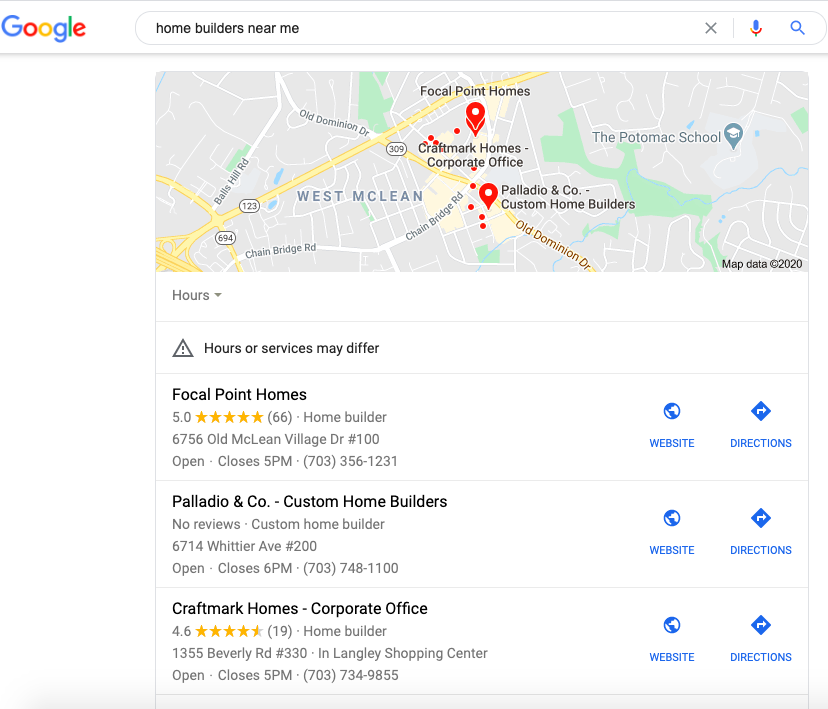
Location assets, which Google formerly called location extensions, pull your address, phone number, and a map marker from your Google Business Profile and display them alongside your ad. If your account is linked to a Business Profile, you are eligible to use them. You can learn more in Google’s location assets help center.
This matters because so many buyers search with local intent, often adding “near me” to their query. Location assets make sure your business appears for nearby searchers and give them the information they need without an extra click. The benefits compound:
- Stronger local visibility. Your ad surfaces for “near me” and city-level searches, frequently above competitors who have not set them up.
- A better user experience. Address, directions, and a tap-to-call number appear right in the result, which reduces friction and builds trust.
- Cleaner tracking. You can see which locations and contact methods drive the most engagement, then shift budget toward what is working.
Keep the underlying Business Profile accurate. Because location assets sync automatically, an outdated address or phone number will broadcast that error to every searcher who sees your ad.
3. Match Every Ad to a Dedicated Landing Page
Sending paid traffic to your homepage is one of the fastest ways to waste a budget. Every ad plays a different role, so every ad deserves a landing page that matches its message. An ad targeting a buyer who is ready to tour a model home should lead to availability and a scheduling form. An ad aimed at someone early in the process should ease their concerns with an FAQ, a financing overview, or a simple request-information form.
Whatever the page, make it fast and mobile-friendly. Most home searches now happen on a phone, and a page that loads slowly or reads poorly on a small screen will lose the click you paid for. Strong message match between the ad and the landing page, paired with one clear call to action, is what turns a visitor into a lead.
4. Re-engage Interested Buyers With Remarketing
Remarketing targets people based on actions they have already taken. If a buyer visited your site and opened your “Contact Us” page but left before submitting the form, you can show them tailored ads over the following days. Given how long the home-buying journey is, this gentle, repeated presence keeps your communities top of mind while a buyer is still comparing options.
Remarketing is proven to improve brand recall, which often translates into more conversions down the line. Pair it with helpful creative, such as a new floor plan, a limited-time incentive, or a virtual tour, so each impression gives the buyer a reason to come back.
5. Let AI Do the Heavy Lifting, With Guardrails
Google Ads now leans heavily on machine learning. Smart Bidding strategies such as Target CPA and Maximize Conversions adjust your bids in real time to win the clicks most likely to convert, which usually outperforms manual bidding once you have enough conversion data. Performance Max takes this further, running a single campaign across Search, Maps, YouTube, Display, and the Discover feed, and works especially well for reach and remarketing.
A word of caution for pure lead generation: Performance Max optimizes toward whatever you define as a conversion. Without accurate tracking and a feedback loop on lead quality, it can chase cheap, low-value form fills instead of real buyers. The fix is to feed the system good data. Import qualified leads and closed sales from your CRM so the AI learns what a genuine buyer looks like, not just what a cheap click looks like. Used this way, automation becomes a force multiplier rather than a budget leak.nly getting qualified traffic, but that you are accessible to that traffic as well.
Below is an example of businesses who use location extensions:
6. Expand Your Reach With Local Services Ads and Microsoft Ads
Google Search is the obvious starting point, but it is not the only channel worth your spend. Local Services Ads appear at the very top of the results and can earn the “Google Guaranteed” badge, an instant trust signal for buyers who are about to spend a significant amount of money.
Builders also tend to overlook Microsoft Advertising, which reaches users on Bing, Yahoo, and DuckDuckGo. That audience often skews older and higher income, exactly the profile of many custom and move-up buyers. Competition is lighter, so your cost per click is frequently lower than on Google. Running a blend of channels gives you fuller market coverage and captures qualified leads your competitors are ignoring.
7. Measure Cost Per Sale, Not Just Clicks
PPC is appealing because everything is measurable, but it is easy to optimize for the wrong number. Clicks and impressions feel productive, yet they do not pay the bills. As industry benchmarks, home builders often see costs per click in the range of a few dollars to several dollars, costs per lead anywhere from roughly thirty to sixty dollars, and a lead-to-sale ratio in the neighborhood of one in ten. These numbers vary widely by market and home price, so treat them as a starting point rather than a promise.
The metric that actually matters to a builder is cost per sale. Because so many high-value inquiries come by phone, use call tracking to capture and attribute those leads, and review call duration and recordings as a signal of lead quality. Tie every lead and sale back to your CRM so you can see which campaigns, keywords, and channels produce signed contracts, then move your budget toward them. That is the difference between a campaign that looks busy and one that builds your business.
Frequently Asked Questions
What is PPC for home builders?
PPC, or pay-per-click advertising, is a model where you pay only when someone clicks your ad. For home builders, it places your communities and homes at the top of search results on platforms like Google Ads and Microsoft Advertising the moment a buyer searches for terms such as “new homes near me” or “custom home builder in [city].” You capture high-intent buyers immediately instead of waiting months for organic rankings to build.
How much do home builder PPC campaigns cost?
Costs vary by market, home price, and competition. As a general guide, costs per click often run from a few dollars to several dollars, and costs per lead frequently land between roughly thirty and sixty dollars. Management budgets differ from builder to builder. Because a single sale can be worth hundreds of thousands of dollars, the more useful question is cost per sale, not cost per click.
Should home builders use Performance Max?
Performance Max can be valuable for reach and remarketing because it runs across all of Google’s channels from one campaign. For pure lead generation, use it with care. It optimizes toward whatever you count as a conversion, so without solid conversion tracking and lead-quality feedback it can produce cheap, low-quality leads. Feed it qualified leads and sales data from your CRM so it learns to find real buyers.
What are location assets in Google Ads?
Location assets, previously known as location extensions, display your business address, phone number, and a map marker alongside your ad. They sync from your Google Business Profile and help your ads stand out for local and “near me” searches while making it easy for buyers to call or get directions.
Which is better for home builders, Google Ads or Microsoft Ads?
Most successful builders use both. Google Ads offers the largest volume of high-intent searches, while Microsoft Advertising reaches an often older, higher-income audience at a lower cost per click with less competition. A blended approach gives you broader coverage and captures leads your competitors may be missing.
How long does it take for PPC to generate leads?
Because paid ads place you at the top of the results immediately, campaigns can begin producing inquiries within hours or days of launching. Reaching peak efficiency takes longer, since Smart Bidding needs conversion data to learn from and the campaign needs time to be refined based on results.
Put These Strategies to Work
Paid advertising rewards builders who treat it as a system rather than a guessing game. Start with tightly targeted local keywords, support your ads with location assets and dedicated landing pages, re-engage interested buyers with remarketing, and let AI bidding work for you with accurate data behind it. Then measure what truly matters: qualified leads and signed contracts. For more on capturing local buyers organically alongside your paid campaigns, explore our local SEO services.
If you would like help building or refining a paid advertising program for your communities, contact our team to talk through your goals and market.
About Fairfax SEO Company
Fairfax SEO Company is a full-service digital marketing agency that manages paid search, local SEO, and lead generation for home builders, contractors, and local service businesses across Virginia, the Washington, DC metro, and beyond. Our team works inside Google Ads and Microsoft Advertising every day, and the guidance above reflects what we see drive real results for builders. Reach us at 877-877-0542, Monday through Friday, 9 a.m. to 5 p.m.
Recent SEO News

The Ultimate Local SEO Guide for Fairfax & Northern Virginia Businesses
When someone nearby searches for a product or service you offer, local SEO decides whether your business shows up or

How Paid Advertising Helps SEO
How Paid Advertising Can Improve Your SEO Strategy and Organic Search Rankings Many business owners view Search Engine Optimization (SEO)